
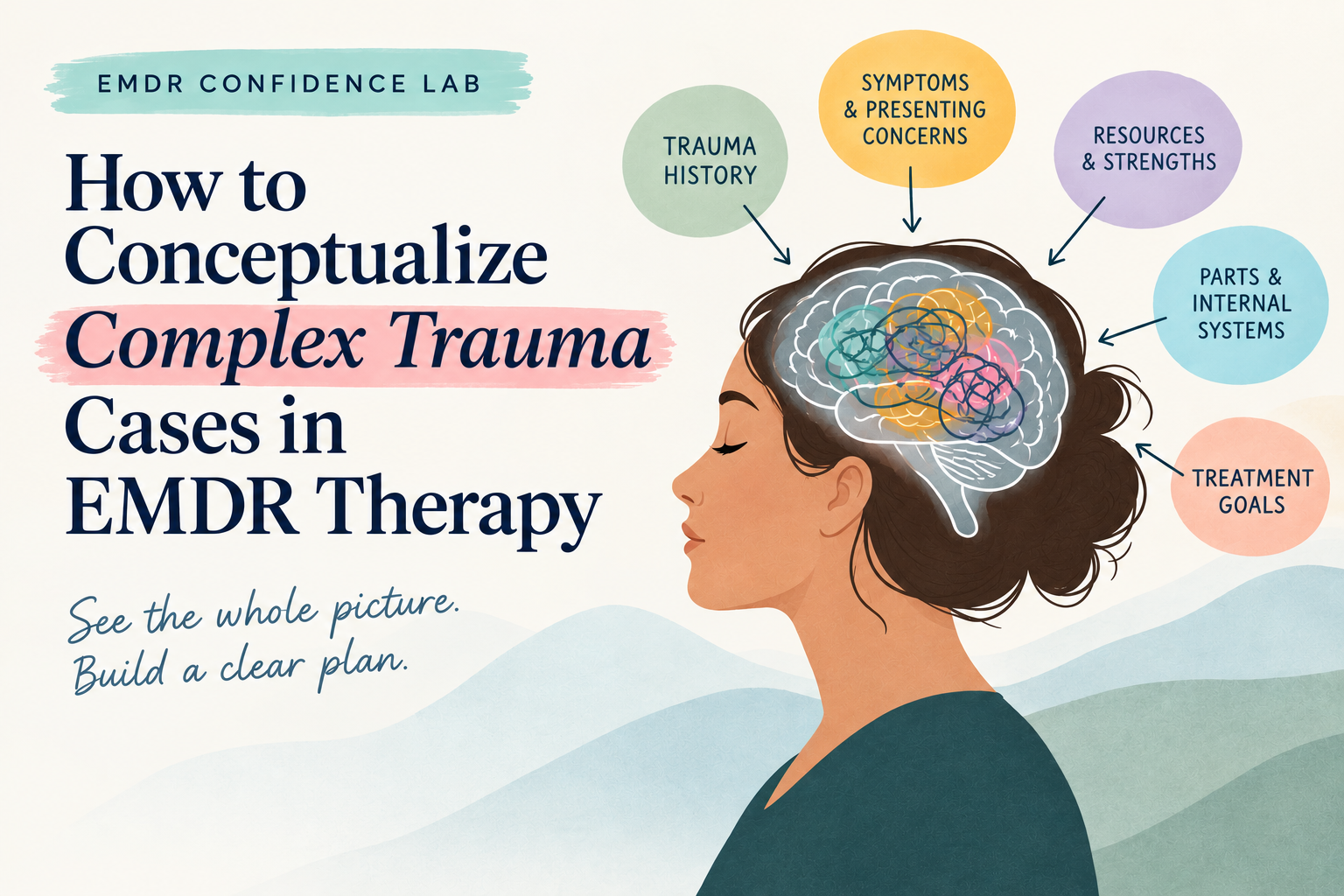
One of the most difficult transitions for newer EMDR therapists is moving from:
“How do I follow the protocol?” to “How do I understand this client?”
That shift is the beginning of real case conceptualization.
Because complex trauma cases rarely fit neatly into simple treatment worksheets.
Clients may arrive with:
shame
attachment wounds
dissociation
eating disorders
panic
emotional numbness
relationship instability
hypervigilance
people pleasing
perfectionism
somatic symptoms
self-criticism
Very likely, underneath all of it may be years of developmental wounds, emotional neglect, relational unpredictability, or nervous system survival adaptations.
Without a strong conceptual framework, EMDR can begin to feel chaotic.
You start to wonder and maybe even start to spiral a bit:
Why does this client keep looping?
What am I doing wrong?
Why does the client suddenly disconnect?
Why isn’t this working?
But once therapists learn how to conceptualize complex trauma more effectively, cases often stop feeling random.
Patterns emerge.
And confidence grows.
And you aren’t googling what other jobs you can do with a license.
Complex Trauma Is Not Just “More Trauma”
One of the most important things therapists learn is this:
Complex trauma is not simply a larger quantity of traumatic experiences.
It is often trauma that occurred:
repeatedly
relationally
developmentally
chronically
unpredictably
without adequate support or repair
This means the trauma impacted not only memory networks—but the development of:
identity
attachment
nervous system regulation
emotional tolerance
self-worth
relational safety
embodiment
Clients with complex trauma often did not simply experience frightening events.
They adapted to unsafe and unpredictable environments over time.
Those adaptations become the symptoms therapists see in adulthood.
Symptoms Are Often Survival Strategies
This is one of the most important conceptual shifts in trauma therapy.
Many behaviors that appear “problematic” are actually adaptive responses to earlier environments. It’s time to rethink our “difficult” clients and view their behaviors as symptoms trying to help them survive.
For example:
Perfectionism-May have developed to avoid criticism, rejection, or unpredictability.
People pleasing-May have helped maintain safety in emotionally volatile relationships.
Emotional numbness-May have protected against overwhelm.
Hyper-independence-May have developed when relying on others felt unsafe.
Dissociation-May have reduced unbearable emotional pain.
Eating disorder behaviors-May have created regulation, control, numbness, or emotional management.
When therapists conceptualize symptoms as adaptations rather than pathology, treatment becomes more compassionate and more accurate. This is being trauma-informed.
Start With the Nervous System
Many newer EMDR therapists focus heavily on cognition and memory. Right? We got to pick the perfect target and NC.
But complex trauma treatment usually begins with the nervous system.
Before asking:
“What memory should we process?”
It can help to look at:
What states does this client live in most often?
Hyperarousal?
Shutdown?
Chronic collapse?
Hypervigilance?
Emotional numbness?
Mixed activation?
Understanding nervous system patterns helps therapists recognize:
triggers
dysregulation cycles
dissociation
capacity limitations
stabilization needs
This also helps explain why some clients appear “functional” while remaining deeply dysregulated internally.
Attachment Patterns Matter Deeply
Attachment trauma often shapes how clients experience:
vulnerability
emotional closeness
dependency
trust
needs
conflict
self-worth
Clients likely unconsciously expect:
abandonment
criticism
rejection
emotional invalidation
disappointment
These expectations frequently emerge inside therapy itself.
For example, clients may:
minimize distress
avoid needing the therapist
become highly compliant
disconnect emotionally
fear being “too much”
Without attachment awareness, therapists may misinterpret these responses as resistance or lack of engagement.
But often they are survival adaptations organized around relational safety.
Dissociation Is Central in Many Complex Trauma Cases
Many therapists underestimate how frequently dissociation appears in complex trauma work.
Dissociation is not always dramatic. It’s often subtle. Context is important. When it shows up is important. Nuance is also important.
It may appear as:
intellectualizing
emotional flatness
body disconnection
“nothing comes up”
excessive insight without embodiment
fogginess
shutdown
over-compliance
“I don’t know”
If dissociation is missed, therapists may:
move too quickly
push processing prematurely
overuse interweaves
misinterpret the nervous system entirely
Conceptualizing dissociation correctly changes pacing, stabilization, and treatment planning significantly.
Understand Protective Systems
Many trauma survivors have highly organized internal protective systems.
These protectors developed intelligently to reduce:
shame
overwhelm
abandonment
vulnerability
helplessness
emotional exposure
Protective parts may appear as:
humor
perfectionism
intellectualization
caretaking
emotional shutdown
control
over-functioning
Therapists who understand protection stop asking:
“Why is this client avoiding?”
And start asking:
“What feels unsafe about this?”
That shift creates far more compassionate treatment.
Target Selection in Complex Trauma Requires Flexibility
Many newer therapists search for a single “big trauma.” Or a trauma that has a beginning and an end.
But complex trauma often involves networks rather than isolated incidents. There is no beginning and end for those with complex trauma.
Important targets may include:
attachment ruptures
emotional neglect
shame memories
chronic relational experiences
body-based experiences
developmental moments
repeated emotional patterns
Sometimes the most clinically significant material is not obviously traumatic.
For example:
being ignored while distressed
feeling emotionally invisible
being responsible for a parent’s emotions
never feeling safe to need support
These experiences shape core beliefs deeply.
Core Beliefs Are Usually Relational
In complex trauma, common negative cognitions often include:
I am too much
I am not enough
I am unsafe
I am powerless
I cannot trust others
My needs aren’t important
I will be abandoned
These beliefs aren’t random.
They usually developed relationally and adaptively. Your client learned this somewhere and likely when they were very young.
Understanding their origin helps treatment feel less symptom-focused and more coherent.
The Therapy Relationship Is Part of the Treatment
Complex trauma clients often organize around relational expectations. Don’t forget-EMDR is relational!
This means the therapy relationship itself becomes clinically significant.
Clients may unconsciously monitor:
therapist reactions
tone shifts
pacing
perceived disappointment
emotional availability
safety
Therapists who conceptualize these dynamics relationally are often better able to:
pace treatment
identify attachment activation
reduce shame
strengthen safety
navigate rupture and repair
Complex Trauma Treatment Is Rarely Linear
This is important for therapists to normalize. And it’s important to let your clients know this to!
Complex trauma work often includes:
looping
shutdown
progress followed by regression
protector activation
emotional overwhelm
periods of stabilization
relational activation
This does not mean therapy is failing.
Healing often unfolds in layers.
Therapists become more confident when they stop expecting linear progress and start expecting nervous system complexity.
Good Conceptualization Reduces Therapist Panic
When therapists lack formulation, sessions can feel unpredictable and alarming.
But conceptualization creates structure.
Suddenly:
dissociation makes sense
looping makes sense
protectors make sense
attachment activation makes sense
emotional shutdown makes sense
The therapist no longer feels lost or is frantically looking for new careers.
They begin thinking clinically rather than reactively.
That shift is enormous.
EMDR Confidence Comes From Learning to Think, Not Memorize
Many therapists initially search for:
perfect scripts
exact interventions
step-by-step certainty
I honestly remember asking my internship supervisor about scripts to help me with clients. But confidence in complex trauma work, or even non-trauma work rarely comes from memorization.
It comes from:
pattern recognition
nervous system understanding
attachment awareness
parts-informed thinking
consultation
clinical flexibility
Strong therapists learn how to think deeply and to be curious—not just what to say.
Frequently Asked Questions
What makes trauma “complex”?
Complex trauma usually involves repeated, relational, developmental, or chronic trauma experiences that impact identity, attachment, and nervous system regulation.
Why do complex trauma clients often dissociate during EMDR?
Dissociation is a protective adaptation that helps reduce overwhelm when emotional activation exceeds nervous system capacity.
How is EMDR different for complex trauma?
Complex trauma often requires slower pacing, stronger stabilization, careful target selection, and greater attention to attachment and dissociation. There is usually more time needed in Phase 2 as well, to make sure there is enough access to adaptive information.
Why does complex trauma treatment feel nonlinear?
Healing often unfolds in layers, with nervous system shifts, protector activation, and changing relational dynamics over time.
Want More Support Conceptualizing Complex Trauma Cases?
EMDR Confidence Lab helps therapists navigate:
✓ dissociation and shutdown
✓ attachment-informed EMDR
✓ parts work integration
✓ nervous system conceptualization
✓ stuck processing
✓ target sequencing
✓ therapist confidence with complexity
Because complex trauma cases are not random.
They are organized adaptations to survival.
Come curious. Leave clearer.
Bring Your Cases to Consultation
You also need a place to say:
“Here's what's happening with my client. Here's what I've tried. And now I'm stuck.”
That's what our Drop-In EMDR Consultation Group is for.
Bring the complicated case. The stuck processing. The target you're questioning. The interweave you're unsure about. The client who isn't responding the way you expected.
You don't have to have your question perfectly figured out before you come.
And because I want consultation to be accessible to EMDR therapists at different stages of their careers, the Drop-In Consultation Group uses tiered pricing: $15, $35, or $50.
Same group. Same consultation. You choose the tier that works for you.
Whether you want to deepen your EMDR knowledge through training, get support with your actual cases through consultation, or do both, the goal is the same:
To help you feel more confident thinking clinically—not just following the protocol.
Confidence Happens in the Lab.
Ready to Build Confidence That Feels Grounded?
EMDR Confidence Lab is consultation for trauma therapists who want:
✓ clinical clarity
✓ nuanced case conceptualization
✓ support with stuck processing
✓ confidence with dissociation and attachment work
✓ thoughtful, relational consultation
✓ real skill development, not rote protocol