
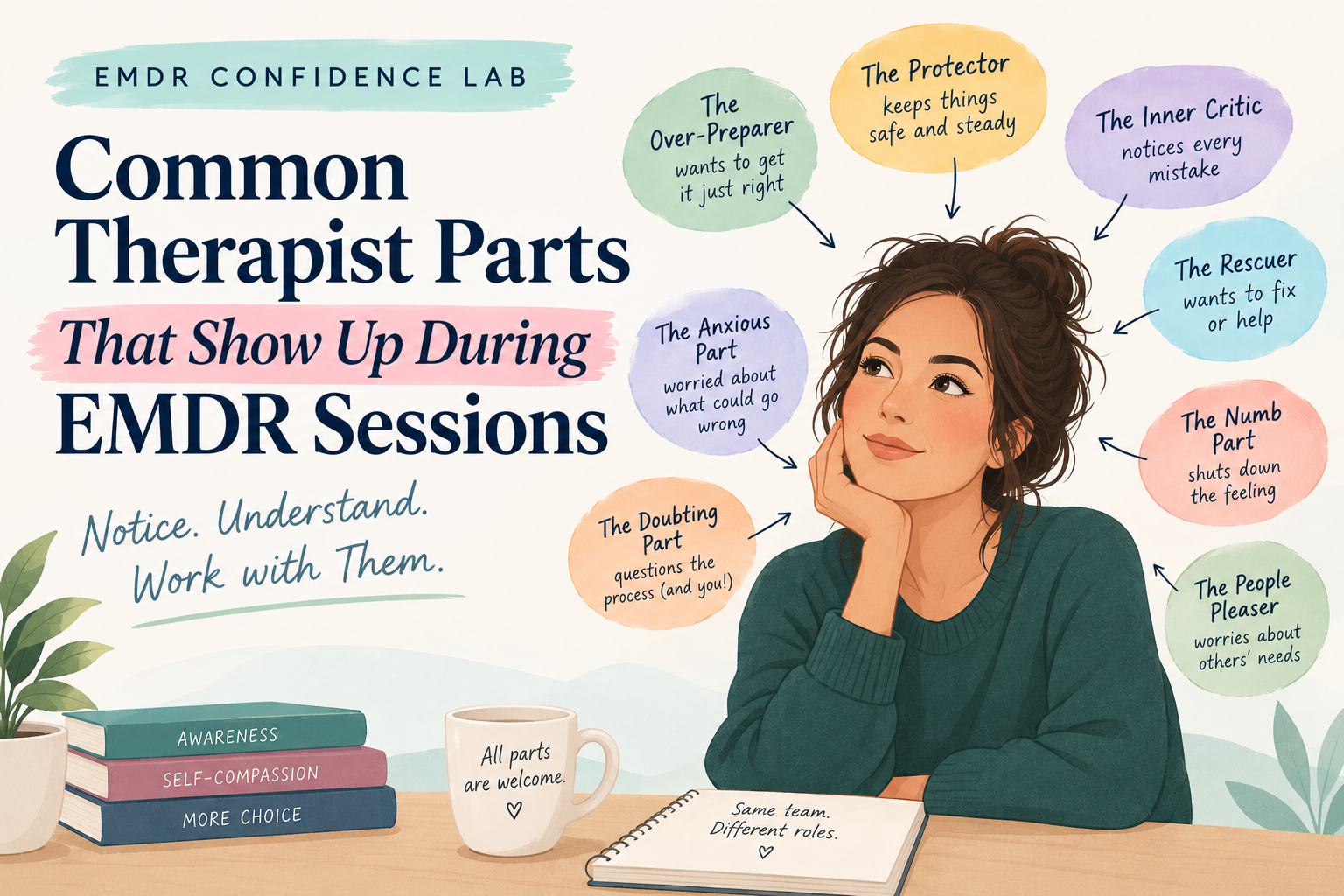
One of the most important things trauma therapists eventually realize is this:
They are also humans.
So…clients are not the only people bringing nervous systems into the room.
Therapists do too.
This matters deeply in EMDR work.
Because EMDR often involves:
uncertainty
intensity
emotional exposure
unpredictability
dissociation
attachment dynamics
nervous system activation
high clinical responsibility
And when therapists feel uncertain, overwhelmed, responsible, or emotionally activated, therapist parts naturally emerge. Maybe even some non-therapists parts too.
This is not failure.
It is human.
Yet many therapists quietly carry shame about their own internal reactions. It’s not surprising, we are typically taught that our own emotions need to stay out of the therapy room.
They believe:
“A good therapist wouldn’t feel anxious.”
“I should know exactly what to do.”
“I shouldn’t feel overwhelmed by this case.”
But self-awareness—not emotional perfection—is what makes trauma treatment safer and more effective.
The more therapists understand their own parts, the more grounded, flexible, and attuned they often become in EMDR work.
What Are Therapist Parts?
Therapist parts are internal responses, adaptations, fears, and protective strategies that become activated during clinical work.
These parts often emerge automatically in response to:
client distress
uncertainty
fear of harming clients
performance pressure
imposter syndrome
attachment dynamics
trauma exposure
clinical complexity
Therapists have internal systems shaped by their own experiences, training environments, attachment histories, and professional cultures, just like our clients do.
Certain parts often become especially activated in trauma work because EMDR asks therapists to tolerate uncertainty while remaining grounded and attuned.
That is not easy work.
Why Therapist Parts Matter in EMDR
Many therapists assume their internal reactions should stay completely separate from treatment. That’s what was engrained in us during grad school right?
But therapists inevitably influence the room through:
pacing
tone
urgency
body language
emotional regulation
intervention style
tolerance for silence
tolerance for vulnerability
Clients track therapists constantly.
Especially trauma survivors.
Many trauma survivors are highly sensitive to subtle nervous system shifts because hypervigilance once helped them survive.
This means therapist activation can unintentionally shape treatment dynamics.
Recognizing therapist parts is not about self-criticism.
It is about increasing awareness and curiosity for our own journeys.
The Fixer Part
One of the most common therapist parts is “the fixer.”
This part often believes:
“I need this client to get better quickly”
“I need to make this better.”
“I should know how to get them unstuck.”
The fixer part usually comes from care.
But it can create subtle urgency in the room.
Therapists may begin:
over-intervening
asking too many questions
rushing processing
increasing intensity too quickly
overusing interweaves
struggling to tolerate pauses
Clients often feel this pressure—especially those with attachment trauma.
And pressure can increase shutdown, dissociation, or compliance.
Sometimes the deepest clinical move is not doing more.
It is slowing down enough to understand what is already happening.
The Performer Part
The performer part often fears appearing incompetent.
This part may think:
“I need to do EMDR correctly and perfectly.”
“I need to sound knowledgeable.”
“I should already understand this.”
This part is common in newer therapists, but experienced clinicians can carry it too.
The performer part often shows up through:
over-structuring sessions
rigid protocol adherence
fear of silence
excessive explaining
anxiety about consultation and avoidance of consultation
comparing oneself to other therapists
Ironically, trying to appear confident often interferes with authentic clinical presence.
Real confidence usually looks quieter.
More flexible.
More curious.
The Rescuer Part
The rescuer part feels emotionally responsible for clients’ pain. Are we even therapists if we aren’t slightly codependent?
This part may experience intense discomfort witnessing suffering.
It often believes:
“I need to save them from this feeling.”
This can lead therapists to:
interrupt processing prematurely
over-soothe
avoid emotional depth
redirect difficult material too quickly
struggle to tolerate grief, helplessness, or anger
While compassion matters deeply, rescuing can sometimes interrupt integration.
Trauma therapy (especially EMDR) usually requires helping clients remain present with painful material—not eliminating pain immediately.
The Perfectionist Part
The perfectionist part often fears making mistakes.
This part may believe:
“If I do this wrong, I could harm the client.”
This fear can create:
excessive self-monitoring
over-preparation (I know some of you are prepping for HOURS before a session).
difficulty trusting intuition
rigid treatment planning
paralysis during uncertainty
chronic self-doubt
Many therapists with perfectionistic parts struggle to tolerate the reality that trauma work is inherently nuanced and nonlinear.
But clinical skill rarely develops through perfection.
It develops through experience, reflection, consultation, and flexibility.
The Afraid Part
Many therapists carry quiet fears in EMDR work.
For example:
fear of destabilizing clients
fear of dissociation
fear of suicidality
fear of intense emotion
fear of getting “stuck”
fear of not knowing what to do
This part often activates strongly in complex trauma work.
And honestly, some fear is appropriate.
Trauma treatment carries responsibility.
But when fear becomes overwhelming, therapists may become:
overly cautious
avoidant of processing
hesitant to trust themselves
rigidly attached to protocol
unable to tolerate uncertainty
Supportive consultation often helps therapists normalize and regulate these fears.
The Overwhelmed Part
Some cases genuinely stretch, and maybe even overwhelm therapists.
Especially cases involving:
severe dissociation
chronic suicidality
eating disorders
developmental trauma
intense attachment wounds
ongoing instability
Therapists may quietly think:
“This feels like too much. I don’t know what to do.”
Without support, overwhelmed parts may lead to:
burnout
emotional numbing
avoidance
frustration
self-doubt
compassion fatigue
This is one reason therapist community and consultation matter so much.
Therapist Parts Often Interact With Client Parts
One of the most fascinating dynamics in trauma work is how therapist and client systems interact.
For example:
a therapist fixer part may activate against a client shutdown part
a therapist perfectionist may activate around a client intellectualizer
a therapist rescuer may activate around a highly dysregulated client
a therapist afraid part may activate around dissociation
Without awareness, these interactions can unconsciously shape pacing and interventions.
With awareness, therapists gain more choice, and in turn more confidence.
Self-Awareness Improves Clinical Flexibility
Therapists do not need to eliminate their parts.
They need to recognize them.
Awareness creates space between reaction and intervention.
Instead of unconsciously acting from urgency, therapists can pause and ask:
What am I feeling right now?
Is this response about the client, me, or both?
Am I trying to reduce the client’s distress—or my own discomfort?
Am I moving too fast?
What feels difficult for me here?
These questions increase attunement significantly.
Consultation Helps Therapists Regulate Their Own Systems
One of the most powerful aspects of good consultation is that it helps therapists feel less alone. And let’s be honest, this job can be very isolating. We can’t talk to others about what we do and can end up feeling really alone.
Consultation normalizes:
uncertainty
overwhelm
confusion
stuckness
countertransference
emotional reactions
That matters because isolated therapists often become more anxious, rigid, or self-critical. I’ll even say something unpopular here and say that isolated therapists can be dangerous.
Supportive consultation creates room for learning instead of performance.
Therapists Are Not Robots
Many clinicians unconsciously believe professionalism means emotional invisibility. The blank slate right?
But good trauma therapists are not detached machines.
They are regulated, reflective humans.
Therapists will have reactions.
The goal is not absence of feeling.
The goal is awareness, regulation, and thoughtful response.
That is what creates safety in the room.
Frequently Asked Questions
Is countertransference normal in EMDR therapy?
Yes. Trauma work naturally activates emotional responses and therapist parts. Awareness and consultation help therapists navigate these reactions skillfully.
Can therapist anxiety affect EMDR sessions?
Yes. Therapist urgency, fear, or over-functioning can unintentionally shape pacing and nervous system dynamics in the room.
How do therapists avoid over-identifying with clients?
Self-awareness, consultation, boundaries, and reflective practice all help therapists remain grounded. And your own therapy too!
Does having therapist parts make someone a bad clinician?
Not at all! It makes you a human being! Having internal reactions is human. Reflective awareness is what matters most.
Want More Support Navigating Therapist Parts in EMDR?
EMDR Confidence Lab helps therapists build confidence with:
✓ therapist countertransference
✓ stuck processing
✓ complex trauma cases
✓ dissociation and shutdown
✓ attachment dynamics
✓ nervous system-informed treatment
✓ therapist confidence and regulation
Because therapists deserve support too.
Come curious. Leave clearer.
Bring Your Cases to Consultation
You also need a place to say:
“Here's what's happening with my client. Here's what I've tried. And now I'm stuck.”
That's what our Drop-In EMDR Consultation Group is for.
Bring the complicated case. The stuck processing. The target you're questioning. The interweave you're unsure about. The client who isn't responding the way you expected.
You don't have to have your question perfectly figured out before you come.
And because I want consultation to be accessible to EMDR therapists at different stages of their careers, the Drop-In Consultation Group uses tiered pricing: $15, $35, or $50.
Same group. Same consultation. You choose the tier that works for you.
Whether you want to deepen your EMDR knowledge through training, get support with your actual cases through consultation, or do both, the goal is the same:
To help you feel more confident thinking clinically—not just following the protocol.
Confidence Happens in the Lab.
Ready to Build Confidence That Feels Grounded?
EMDR Confidence Lab is consultation for trauma therapists who want:
✓ clinical clarity
✓ nuanced case conceptualization
✓ support with stuck processing
✓ confidence with dissociation and attachment work
✓ thoughtful, relational consultation
✓ real skill development, not rote protocol